The Story of Patriarchs and Prophets
by Ellen G. White
Chapter 24: The Passover
When the demand for Israel's release had been first
presented to the king of Egypt, the warning of the most
terrible of the plagues had been given. Moses was directed to say
to Pharaoh, "Thus saith the Lord, Israel is My son, even My first-born:
and I say unto thee, Let My son go, that he may serve Me:
and if thou refuse to let him go, behold, I will slay thy son, even
thy first-born." Exodus 4:22, 23. Though despised by the
Egyptians, the Israelites had been honored by God, in that they were
singled out to be the depositaries of His law. In the special
blessings and privileges accorded them, they had pre-eminence
among the nations, as the first-born son had among brothers.
The judgment of which Egypt had first been warned, was to
be the last visited. God is long-suffering and plenteous in mercy.
He has a tender care for the beings formed in His image. If the
loss of their harvests and their flocks and herds had brought
Egypt to repentance, the children would not have been smitten;
but the nation had stubbornly resisted the divine command, and
now the final blow was about to fall.
Moses had been forbidden, on pain of death, to appear again
in Pharaoh's presence; but a last message from God was to be
delivered to the rebellious monarch, and again Moses came
before him, with the terrible announcement: "Thus saith the Lord,
About midnight will I go out into the midst of Egypt: and all
the first-born in the land of Egypt shall die, from the first-born of
Pharaoh that sitteth upon his throne, even unto the first-born
of the maidservant that is behind the mill; and all the first-born of
beasts. And there shall be a great cry throughout all the land of
Egypt, such as there was none like it, nor shall be like it any
more. But against any of the children of Israel shall not a dog
move his tongue, against man or beast: that ye may know how [p. 274] that the Lord doth put a difference between the Egyptians and
Israel. And all these thy servants shall come down unto me, and
bow down themselves unto me, saying, Get thee out, and all the
people that follow thee: and after that I will go out."
Before the execution of this sentence the Lord through Moses
gave direction to the children of Israel concerning their departure
from Egypt, and especially for their preservation from the
coming judgment. Each family, alone or in connection with
others, was to slay a lamb or a kid "without blemish," and with
a bunch of hyssop sprinkle its blood on "the two side posts and
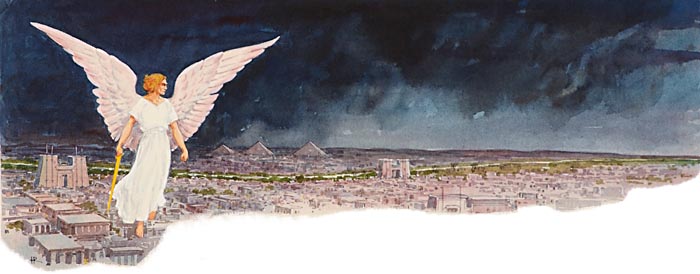
on the upper doorpost" of the house, that the destroying angel,
coming at midnight, might not enter that dwelling. They were
to eat the flesh roasted, with unleavened bread and bitter herbs, at
night, as Moses said, "with your loins girded, your shoes on your
feet, and your staff in your hand; and ye shall eat it in haste: it
is the Lord's Passover."
The Lord declared: "I will pass through the land of Egypt
this night, and will smite all the first-born in the land of Egypt,
both man and beast; and against all the gods of Egypt I will
execute judgment. . . . And the blood shall be to you for a token
upon the houses where ye are: and when I see the blood, I will
pass over you, and the plague shall not be upon you to destroy
you, when I smite the land of Egypt."
In commemoration of this great deliverance a feast was to be
observed yearly by the people of Israel in all future generations.
"This day shall be unto you for a memorial; and ye shall keep it a
feast to the Lord throughout your generations: ye shall keep it
a feast by an ordinance forever." As they should keep the feast
in future years, they were to repeat to their children the story of
this great deliverance, as Moses bade them: "Ye shall say, It is the
sacrifice of the Lord's Passover, who passed over the houses of the
children of Israel in Egypt, when He smote the Egyptians, and
delivered our houses."
Furthermore, the first-born of both man and beast were to be
the Lord's, to be bought back only by a ransom, in acknowledgment
that when the first-born in Egypt perished, that of Israel,
though graciously preserved, had been justly exposed to the same
doom but for the atoning sacrifice. "All the first-born are Mine,"
the Lord declared; "for on the day that I smote all the first-born [p. 277] in the land of Egypt, I hallowed unto Me all the first-born in
Israel, both man and beast: Mine they shall be," Numbers 3:13.
After the institution of the tabernacle service the Lord chose
unto Himself the tribe of Levi for the work of the sanctuary,
instead of the first-born of the people. "They are wholly given
unto Me from among the children of Israel," He said. "Instead
of the first-born of all the children of Israel, have I taken them
unto Me." Numbers 8:16. All the people were, however, still
required, in acknowledgment of God's mercy, to pay a redemption
price for the first-born son. Numbers 18:15, 16.
The Passover was to be both commemorative and typical, not
only pointing back to the deliverance from Egypt, but forward
to the greater deliverance which Christ was to accomplish in
freeing His people from the bondage of sin. The sacrificial lamb
represents "the Lamb of God," in whom is our only hope of
salvation. Says the apostle, "Christ our Passover is sacrificed for us."
1 Corinthians 5:7. It was not enough that the paschal lamb be
slain; its blood must be sprinkled upon the doorposts; so the
merits of Christ's blood must be applied to the soul. We must
believe, not only that He died for the world, but that He died
for us individually. We must appropriate to ourselves the virtue
of the atoning sacrifice.
The hyssop used in sprinkling the blood was the symbol of
purification, being thus employed in the cleansing of the leper
and of those defiled by contact with the dead. In the psalmist's
prayer also its significance is seen: "Purge me with hyssop, and
I shall be clean: wash me, and I shall be whiter than snow."
Psalm 51:7.
The lamb was to be prepared whole, not a bone of it being
broken: so not a bone was to be broken of the Lamb of God, who
was to die for us. John 19:36. Thus was also represented the
completeness of Christ's sacrifice.
The flesh was to be eaten. It is not enough even that we believe on Christ for the forgiveness of sin; we must by faith be constantly receiving spiritual strength and nourishment from Him through His word. Said Christ, "Except ye eat the flesh of the Son of man, and drink His blood, ye have no life in you. Whoso eateth My flesh, and drinketh My blood, hath eternal life." John 6:53, 54. And to explain His meaning He said, "The words that I speak unto you, they are spirit, and they are life." Verse 63. Jesus [p. 278] accepted His Father's law, wrought out its principles in His life, manifested its spirit, and showed its beneficent power in the heart. Says John, "The Word was made flesh and dwelt among us, (and we beheld His glory, the glory as of the only begotten of the Father,) full of grace and truth." John 1:14. The followers of Christ must be partakers of His experience. They must receive and assimilate the word of God so that it shall become the motive power of life and action. By the power of Christ they must be changed into His likeness, and reflect the divine attributes. They must eat the flesh and drink the blood of the Son of God, or there is no life in them. The spirit and work of Christ must become the spirit and work of His disciples.
The lamb was to be eaten with bitter herbs, as pointing back to the bitterness of the bondage in Egypt. So when we feed upon Christ, it should be with contrition of heart, because of our sins. The use of unleavened bread also was significant. It was expressly enjoined in the law of the Passover, and as strictly observed by the Jews in their practice, that no leaven should be found in their houses during the feast. In like manner the leaven of sin must be put away from all who would receive life and nourishment from Christ. So Paul writes to the Corinthian church, "Purge out therefore the old leaven, that ye may be a new lump. . . . For even Christ our Passover is sacrificed for us: therefore let us keep the feast, not with old leaven, neither with the leaven of malice and wickedness; but with the unleavened bread of sincerity and truth." 1 Corinthians 5:7, 8.
Before obtaining freedom, the bondmen must show their faith in the great deliverance about to be accomplished. The token of blood must be placed upon their houses, and they must separate themselves and their families from the Egyptians, and gather within their own dwellings. Had the Israelites disregarded in any particular the directions given them, had they neglected to separate their children from the Egyptians, had they slain the lamb, but failed to strike the doorpost with blood, or had any gone out of their houses, they would not have been secure. They might have honestly believed that they had done all that was necessary, but their sincerity would not have saved them. All who failed to heed the Lord's directions would lose their first-born by the hand of the destroyer. [p. 279]
Find out more today how to get a special discount when you purchase a
hardcover or
paperback
copy of Patriarchs and Prophets.
|
|
By obedience the people were to give evidence of their faith. So all who hope to be saved by the merits of the blood of Christ should realize that they themselves have something to do in securing their salvation. While it is Christ only that can redeem us from the penalty of transgression, we are to turn from sin to obedience. Man is to be saved by faith, not by works; yet his faith must be shown by his works. God has given His Son to die as a propitiation for sin, He has manifested the light of truth, the way of life, He has given facilities, ordinances, and privileges; and now man must co-operate with these saving agencies; he must appreciate and use the helps that God has provided—believe and obey all the divine requirements.
As Moses rehearsed to Israel the provisions of God for their deliverance, "the people bowed the head and worshiped." The glad hope of freedom, the awful knowledge of the impending judgment upon their oppressors, the cares and labors incident to their speedy departure—all were for the time swallowed up in gratitude to their gracious Deliverer. Many of the Egyptians had been led to acknowledge the God of the Hebrews as the only true God, and these now begged to be permitted to find shelter in the homes of Israel when the destroying angel should pass through the land. They were gladly welcomed, and they pledged themselves henceforth to serve the God of Jacob and to go forth from Egypt with His people.
The Israelites obeyed the directions that God had given. Swiftly and secretly they made their preparations for departure. Their families were gathered, the paschal lamb slain, the flesh roasted with fire, the unleavened bread and bitter herbs prepared. The father and priest of the household sprinkled the blood upon the doorpost, and joined his family within the dwelling. In haste and silence the paschal lamb was eaten. In awe the people prayed and watched, the heart of the eldest born, from the strong man down to the little child, throbbing with indefinable dread. Fathers and mothers clasped in their arms their loved first-born as they thought of the fearful stroke that was to fall that night. But no dwelling of Israel was visited by the death-dealing angel. The sign of blood—the sign of a Saviour's protection—was on their doors, and the destroyer entered not.
At midnight "there was a great cry in Egypt: for there was [p. 280] not a house where there was not one dead." All the first-born in the land, "from the firstborn of Pharaoh that sat on his throne unto the firstborn of the captive that was in the dungeon; and all the firstborn of cattle" had been smitten by the destroyer. Throughout the vast realm of Egypt the pride of every household had been laid low. The shrieks and wails of the mourners filled the air. King and courtiers, with blanched faces and trembling limbs, stood aghast at the overmastering horror. Pharaoh remembered how he had once exclaimed, "Who is Jehovah, that I should obey His voice to let Israel go? I know not Jehovah, neither will I let Israel go." Now, his heaven-daring pride humbled in the dust, he "called for Moses and Aaron by night, and said, Rise up, and get you forth from among my people, both ye and the children of Israel; and go, serve the Lord, as ye have said. Also take your flocks and your herds, as ye have said. . . . And be gone; and bless me also." The royal counselors also and the people entreated the Israelites to depart "out of the land in haste; for they said, We be all dead men."
Click here to read the next chapter:
"The Exodus"
|