The Story of Patriarchs and Prophets
by Ellen G. White
Chapter 49: The Last Words of Joshua
The wars and conquest ended, Joshua had withdrawn to the
peaceful retirement of his home at Timnath-serah. "And it
came to pass, a long time after that the Lord had given rest unto
Israel from all their enemies round about, that Joshua . . . called
for all Israel, and for their elders, and for their heads, and for
their judges, and for their officers."
Some years had passed since the people had settled in their
possessions, and already could be seen cropping out the same evils
that had heretofore brought judgments upon Israel. As Joshua
felt the infirmities of age stealing upon him, and realized that
his work must soon close, he was filled with anxiety for the future
of his people. It was with more than a father's interest that he
addressed them, as they gathered once more about their aged
chief. "Ye have seen," he said, "all that the Lord your God hath
done unto all these nations because of you; for the Lord your God
is He that hath fought for you." Although the Canaanites had
been subdued, they still possessed a considerable portion of the
land promised to Israel, and Joshua exhorted his people not to
settle down at ease and forget the Lord's command to utterly
dispossess these idolatrous nations.
The people in general were slow to complete the work of
driving out the heathen. The tribes had dispersed to their
possessions, the army had disbanded, and it was looked upon as a
difficult and doubtful undertaking to renew the war. But Joshua
declared: "The Lord your God, He shall expel them from before
you, and drive them from out of your sight; and ye shall possess
their land, as the Lord your God hath promised unto you. Be
ye therefore very courageous to keep and to do all that is written
in the book of the law of Moses, that ye turn not aside therefrom
to the right hand or to the left." [p. 522]
Joshua appealed to the people themselves as witnesses that, so
far as they had complied with the conditions, God had faithfully
fulfilled His promises to them. "Ye know in all your hearts and
in all your souls," he said, "that not one thing hath failed of all
the good things which the Lord your God spake concerning you;
all are come to pass unto you, and not one thing hath failed
thereof." He declared to them that as the Lord had fulfilled His
promises, so He would fulfill His threatenings. "It shall come to
pass, that as all good things are come upon you, which the Lord
your God promised you; so shall the Lord bring upon you all
evil things. . . . When ye have transgressed the covenant of the
Lord, . . . then shall the anger of the Lord be kindled against
you, and ye shall perish quickly from off the good land which He
hath given unto you."
Satan deceives many with the plausible theory that God's love
for His people is so great that He will excuse sin in them; he
represents that while the threatenings of God's word are to serve
a certain purpose in His moral government, they are never to be
literally fulfilled. But in all His dealings with his creatures God
has maintained the principles of righteousness by revealing sin
in its true character—by demonstrating that its sure result is
misery and death. The unconditional pardon of sin never has
been, and never will be. Such pardon would show the abandonment
of the principles of righteousness, which are the very
foundation of the government of God. It would fill the unfallen
universe with consternation. God has faithfully pointed out the
results of sin, and if these warnings were not true, how could we
be sure that His promises would be fulfilled? That so-called
benevolence which would set aside justice is not benevolence but
weakness.
God is the life-giver. From the beginning all His laws were
ordained to life. But sin broke in upon the order that God had
established, and discord followed. So long as sin exists, suffering
and death are inevitable. It is only because the Redeemer has
borne the curse of sin in our behalf that man can hope to escape,
in his own person, its dire results.
Before the death of Joshua the heads and representatives of the
tribes, obedient to his summons, again assembled at Shechem.
No spot in all the land possessed so many sacred associations,
carrying their minds back to God's covenant with Abraham
and Jacob, and recalling also their own solemn vows upon their [p. 523] entrance into Canaan. Here were the mountains Ebal and
Gerizim, the silent witnesses of those vows which now, in the
presence of their dying leader, they had assembled to renew. On
every side were evidences of what God had wrought for them;
how He had given them a land for which they did not labor, and
cities which they built not, vineyards and oliveyards which they
planted not. Joshua reviewed once more the history of Israel,
recounting the wonderful works of God, that all might have a
sense of His love and mercy and might serve Him "in sincerity
and in truth."
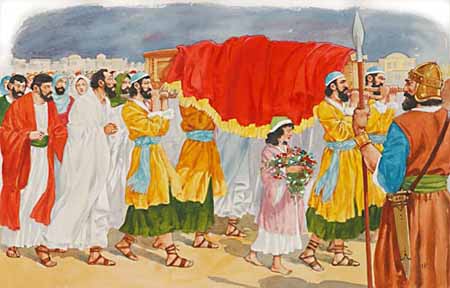
By Joshua's direction the ark had been brought from Shiloh.
The occasion was one of great solemnity, and this symbol of
God's presence would deepen the impression he wished to make
upon the people. After presenting the goodness of God toward
Israel, he called upon them, in the name of Jehovah, to choose
whom they would serve. The worship of idols was still to some
extent secretly practiced, and Joshua endeavored now to bring
them to a decision that should banish this sin from Israel. "If
it seem evil unto you to serve Jehovah," he said, "choose you this
day whom ye will serve." Joshua desired to lead them to serve
God, not by compulsion, but willingly. Love to God is the very
foundation of religion. To engage in His service merely from
hope of reward or fear of punishment would avail nothing. Open
apostasy would not be more offensive to God than hypocrisy and
mere formal worship.
The aged leader urged the people to consider, in all its bearings,
what he had set before them, and to decide if they really
desired to live as did the degraded idolatrous nations around
them. If it seemed evil to them to serve Jehovah, the source of
power, the fountain of blessing, let them that day choose whom
they would serve—"the gods which your fathers served," from
whom Abraham was called out, "or the gods of the Amorites, in
whose land ye dwell." These last words were a keen rebuke to
Israel. The gods of the Amorites had not been able to protect
their worshipers. Because of their abominable and debasing sins,
that wicked nation had been destroyed, and the good land which
they once possessed had been given to God's people. What folly
for Israel to choose the deities for whose worship the Amorites
had been destroyed! "As for me and my house," said Joshua,
"we will serve Jehovah." The same holy zeal that inspired the
leader's heart was communicated to the people. His appeals [p. 524] called forth the unhesitating response, "God forbid that we should
forsake Jehovah, to serve other gods."
"Ye cannot serve the Lord," said Joshua: "for He is a holy
God; . . . He will not forgive your transgressions nor your sins."
Before there could be any permanent reformation the people
must be led to feel their utter inability in themselves to render
obedience to God. They had broken His law, it condemned
them as transgressors, and it provided no way of escape. While
they trusted in their own strength and righteousness, it was
impossible for them to secure the pardon of their sins; they
could not meet the claims of God's perfect law, and it was in
vain that they pledged themselves to serve God. It was only by
faith in Christ that they could secure pardon of sin and receive
strength to obey God's law. They must cease to rely upon their
own efforts for salvation, they must trust wholly in the merits of
the promised Saviour, if they would be accepted of God.
Find out more today how to get a special discount when you purchase a
hardcover or
paperback
copy of Patriarchs and Prophets.
|
|
Joshua endeavored to lead his hearers to weigh well their
words, and refrain from vows which they would be unprepared
to fulfill. With deep earnestness they repeated the declaration:
"Nay; but we will serve the Lord." Solemnly consenting to the
witness against themselves that they had chosen Jehovah, they
once more reiterated their pledge of loyalty: "The Lord our God
will we serve, and His voice will we obey.
"So Joshua made a covenant with the people that day, and
set them a statute and an ordinance in Shechem." Having
written an account of this solemn transaction, he placed it, with
the book of the law, in the side of the ark. And he set up a pillar
as a memorial, saying, "Behold, this stone shall be a witness unto
us; for it hath heard all the words of the Lord which He spake
unto us; it shall be therefore a witness unto you, lest ye deny
your God. So Joshua let the people depart, every man unto his
inheritance."
Joshua's work for Israel was done. He had "wholly followed
the Lord;" and in the book of God he is written, "The servant of
Jehovah." The noblest testimony to his character as a public
leader is the history of the generation that had enjoyed his labors:
"Israel served the Lord all the days of Joshua, and all the days of
the elders that overlived Joshua."
Click here to read the next chapter:
"Tithes and Offerings"
|